BFCM Post-Analysis & Cyber Monday Transition: How to Turn BFCM Data into Christmas Revenue
Revenue is not profit. The 48 hours after Cyber Monday are your most important analytical window. Learn the true BFCM profit calculation, how to find winning products and channels using Growth Links data, three BFCM-to-Christmas transition strategies, and how to build your Christmas campaign directly from BFCM learnings.

Muhammed Tüfekyapan
Key Takeaways
- 1 The 48 hours after Cyber Monday are the most important analytical window of the year - schedule your analysis session for December 1-2 while context is fresh and data is complete
- 2 Revenue is not profit - calculate true BFCM profit by subtracting discount cost, ad spend, creative costs, and operational overhead from your total revenue number
- 3 Growth Links data shows exact per-channel attribution: which channels drove the most conversions, revenue, and ROI - not Google Analytics guesswork but real link-level tracking
- 4 Three BFCM-to-Christmas transition strategies: Clean Break for premium brands, Clearance Bridge for inventory-heavy stores, and Direct Flow for gift-oriented categories
- 5 Phase 3 of BFCM is Phase 1 of Christmas - use your BFCM product winners, channel data, discount depth learnings, and new customer segments to build a Christmas campaign based on real data
- 6 Every BFCM failure becomes a Christmas prevention checklist item - stock-outs, email deliverability issues, site slowdowns, and broken links should all be documented and fixed before December
Cyber Monday is over. You know your revenue number. But revenue is not profit. The stores that win December are the ones that use the next 48 hours for a complete bfcm post analysis shopify review. They calculate true profit, find their winning products and channels, and build their Christmas campaign from real data.
This guide covers the full black friday to christmas transition framework. The 48-hour analysis window. True profit calculation. Product, channel, and discount depth winners using Growth Links data. Three transition strategies. And how to turn your BFCM data into a Christmas plan that starts on December 1.
Most stores celebrate their BFCM revenue, rest for a week, and then scramble to plan Christmas from scratch. Smart stores spend December 1-3 on their post bfcm campaign review and immediately apply those learnings. Phase 3 of BFCM is Phase 1 of Christmas. The stores that understand this win both events. The stores that skip the analysis repeat the same mistakes every year.
The 48-Hour Window: Why Post-BFCM Analysis Cannot Wait
The 48 hours after Cyber Monday are the most important analytical window of the year. Your bfcm results analysis framework must start here. Context is fresh. Your team remembers what happened. Data is complete. Every detail is still clear in everyone's mind.
After one week, context fades. After two weeks, the team has moved on to Christmas. The analysis never happens. The same mistakes repeat next year. You will remember your revenue number, but you will forget which email subject line failed, which product went out of stock on Saturday afternoon, and which ad campaign overspent on Sunday.
Your BFCM data answers the questions that matter most. Which products drove the most profit? Which channels converted best? Which discount depth actually worked? What broke? Growth Links data is especially valuable here. Each link tracked views, conversions, and revenue per channel. This is not Google Analytics guesswork. This is exact attribution: "VIP email drove $12,000. Instagram drove $3,200. The influencer link drove $1,800."
Schedule a 2-hour analysis session for December 1 or 2. Block the calendar. Make it non-negotiable. Your complete bfcm post analysis shopify process starts in this meeting. Bring your team, bring your data, and write everything down. This is also day one of your black friday to christmas transition planning.
Key Insight: The 48-hour window is not about rushing. It is about capturing context while it is fresh. Your team will remember that the homepage banner loaded slowly on Friday morning, that a hero product went out of stock at 2 PM on Saturday, and that the Cyber Monday email had a broken link. Two weeks from now, they will not. Write it all down within 48 hours.
Calculate True BFCM Profit: Revenue Is Just the Start
Revenue is the number everyone celebrates. Profit is the number that matters. Your bfcm results analysis framework must start with this simple question: how much money did you actually keep?
Here is the true BFCM profit calculation:
Most stores skip this math. They see $50,000 in revenue and feel great. But look closer. Store A did $50,000 with 35% average discount depth and $5,000 in ad spend. Store B did $30,000 with 18% average discount depth and $1,500 in ad spend. Store A's discount cost was $17,500. Store B's discount cost was $5,400. When you subtract everything, Store B kept more profit from less revenue.
| Metric | Store A | Store B |
|---|---|---|
| Revenue | $50,000 | $30,000 |
| Avg Discount Depth | 35% | 18% |
| Discount Cost | $17,500 | $5,400 |
| Ad Spend | $5,000 | $1,500 |
| True Profit | $27,500 | $23,100 |
Check your average effective discount across the full BFCM period. In 2025, stores that kept their average discount under 30% outperformed deep discounters in profit margin. What was your average? Did VIP early access at 25% generate more profit per order than Cyber Monday at 15%? This profit calculation is the core of your bfcm post analysis shopify review and feeds directly into your holiday campaign roi shopify analysis.
Warning: Do not compare BFCM revenue to a normal week and call it a success. Compare BFCM profit to what you would have earned at regular prices with regular traffic. Some stores run BFCM campaigns that generate more revenue but less profit than a normal November week. The discount cost and ad spend can erase the revenue gain entirely.
Find Your Winners: Products, Channels, and Discount Depth
After you calculate true profit, dig into the details. Your post bfcm campaign review needs to answer three questions: which products won, which channels won, and which discount depth won. Each answer feeds directly into your Christmas campaign plan.
Product Winners
Which hero products drove the most profit? Not just the most revenue. A product that sold 200 units at 35% off may have generated less profit than one that sold 80 units at 15% off. Use Growth Suite's Product Report to compare. Products that performed as Stars (high traffic plus high add-to-cart rate) during BFCM are your Christmas hero products too. Did any lower-traffic products surprise you with strong conversion? Those are hidden gems for Christmas.
Which products went out of stock? When? Stock-outs during peak hours are unrecoverable lost revenue. Write down every stock-out with the exact time. This becomes your Christmas inventory prevention checklist.

Channel Winners
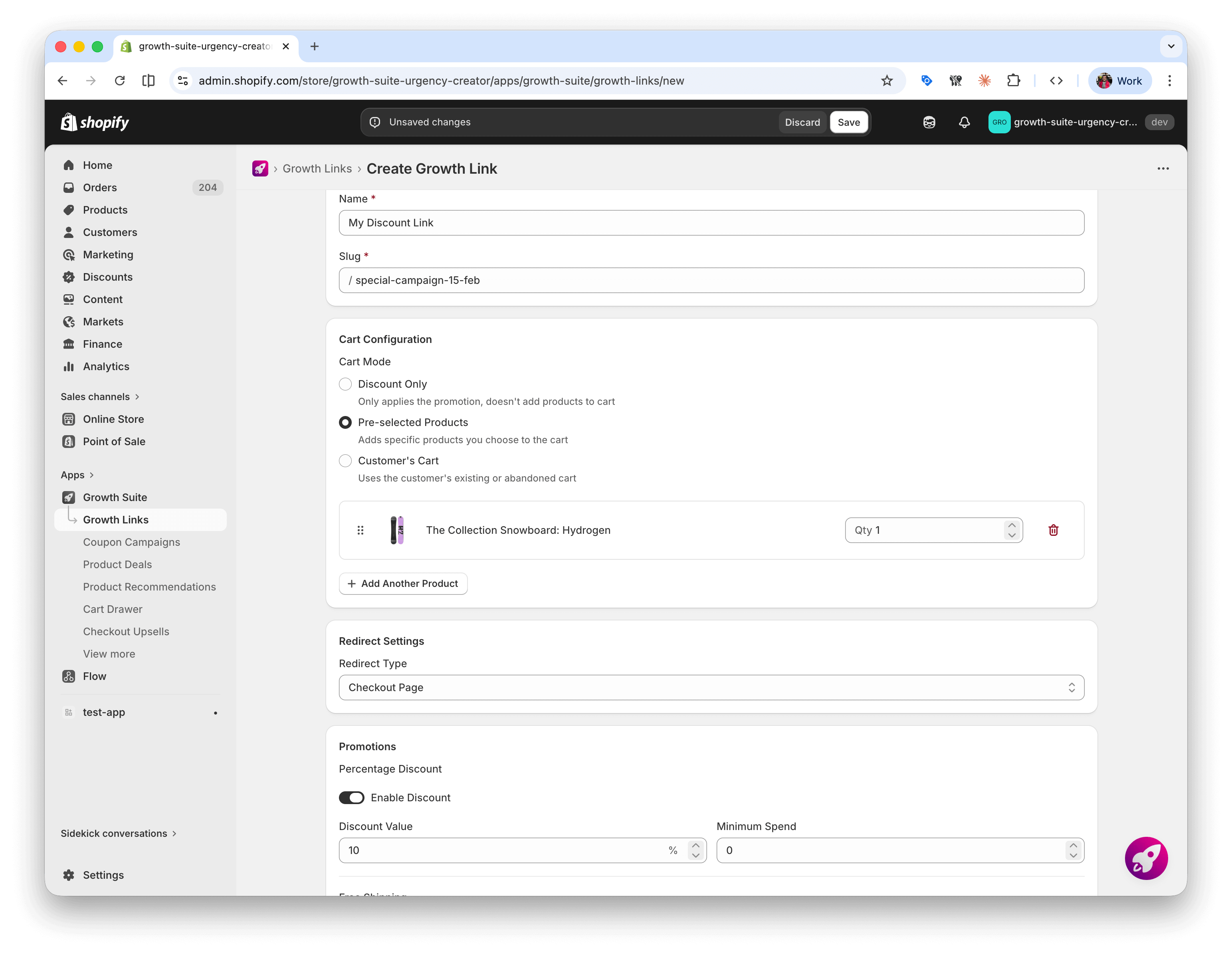
This is where Growth Links data becomes essential for your holiday campaign roi shopify analysis. Each channel had its own Growth Link during BFCM. Now you see exactly what each channel delivered.
Compare per-channel metrics: views, conversions, revenue, and conversion rate. Did VIP email outperform general email? Did Instagram outperform paid ads? Did the influencer link justify the cost? Calculate cost-per-acquisition per channel. Email has near-zero cost. Paid ads have high cost. The ROI comparison tells you where to invest for Christmas.
Discount Depth Winners
Which discount tier converted the best? Compare conversion rate and average order value across VIP early access (20-30%), main weekend (15-25%), and Cyber Monday (10-20%). Did tiered discounts increase AOV? Compare BFCM AOV to your normal AOV. If tiered discounts pushed AOV from $90 to $130, that strategy works for Christmas too. This data is the most valuable part of your bfcm results analysis framework and feeds directly into your black friday to christmas transition plan.
| Analysis Area | Key Question | Data Source | Christmas Application |
|---|---|---|---|
| Products | Which drove the most profit? | Product Report | Christmas hero product selection |
| Channels | Which converted best per dollar? | Growth Links data | Christmas budget allocation |
| Discount Depth | Which tier had the best ROI? | Campaign analytics | Christmas discount strategy |
| Email Segments | Which segments converted? | Email platform | Christmas email targeting |
| Failures | What broke and when? | Team retrospective | Christmas prevention checklist |
Key Insight: Most stores know their total BFCM revenue but cannot tell you which channel drove the most profit. Growth Links give you exact per-channel attribution. "Email drove $12,000 at $0.03 per click. Paid ads drove $8,000 at $2.50 per click." That data tells you exactly where to invest your Christmas budget. Your post bfcm campaign review is only as good as your tracking data.
The BFCM-to-Christmas Transition: Three Strategies
BFCM does not end on Cyber Monday. The most important black friday to christmas transition decision is your messaging shift. During BFCM, customers buy for themselves. During Christmas, they buy gifts for others. The shift from "deals for you" to "gifts for them" defines your cyber monday transition strategy.
There are three ways to make this transition. Each one works for a different type of store.
Option 1: Clean Break
End all BFCM pricing immediately after Cyber Monday. Return to full prices. Launch your Christmas campaign 5-7 days later with fresh, gift-focused positioning. This is the best bfcm christmas transition shopify option for premium brands that want clear separation between deal events. The risk is you lose momentum during the gap. But for premium brands, the clean break protects brand perception. Growth Suite execution: deactivate your Scheduled Campaign. Use one-click price rollback to restore original prices. Plan a new Scheduled Campaign for Christmas launch.
Option 2: Clearance Bridge
Transition BFCM discounts to clearance levels for 3-5 days (December 1-5). Move remaining inventory at reduced prices. Then launch your Christmas campaign by December 6-7. This works best for stores with leftover BFCM inventory. The messaging shifts from "Black Friday deals" to "Final clearance" to "Holiday gift guide." Growth Suite execution: adjust prices to clearance levels. Create new Growth Links for clearance campaign tracking.
Option 3: Direct Flow
No pause at all. Transition BFCM directly into Christmas. Shift messaging immediately from "deals for you" to "gifts for them." Adjust product focus from self-purchase items to gift-worthy items. This is the best cyber monday transition strategy for stores where BFCM and Christmas overlap naturally: fashion accessories, home goods, gift-oriented categories. Growth Suite execution: update Scheduled Campaign dates and messaging. Adjust Trigger Campaign parameters for gift shoppers. Create new Growth Links for Christmas channels.
| Option | Best For | Timing | Messaging Shift |
|---|---|---|---|
| Clean Break | Premium brands | 5-7 day gap | Pause, then Christmas launch |
| Clearance Bridge | Inventory-heavy stores | 3-5 day overlap | "Final sale" to "Holiday gifts" |
| Direct Flow | Gift-oriented categories | Immediate | "Deals for you" to "Gifts for them" |
Warning: You must choose your bfcm christmas transition shopify strategy before Cyber Monday ends. Stores that drift without a plan lose 5-7 days of momentum while competitors are already selling Christmas. Decide before the weekend. Execute on December 1.
Build Your Christmas Campaign from BFCM Data
Phase 3 of BFCM is Phase 1 of Christmas. Here is how to translate your bfcm post analysis shopify data into a Christmas plan that starts working on December 1.
Hero products for Christmas: Take your BFCM product winners. Which ones are also gift-worthy? Those headline your Christmas campaign. If a product was a Star during BFCM (high traffic plus high add-to-cart), it is probably a Christmas Star too. But shift the positioning from "treat yourself" to "perfect gift for them."
Channel allocation for Christmas: Your Growth Links data shows exactly which channels converted during BFCM. Allocate your Christmas ad budget to the channels that actually worked. If email drove 40% of BFCM revenue at near-zero cost, email should get significant Christmas investment too. If paid ads had a high cost-per-acquisition but low conversion, reduce that budget and move it to what works.
Discount depth for Christmas: BFCM taught you which discount tier converts best for your audience. Apply that learning. If 15-20% converted well during BFCM, start Christmas at a similar level. You do not need to guess. You have real data now.
Email segments for Christmas: BFCM created new segments. New customers acquired during BFCM. VIP buyers who spent big. Walk-away visitors who browsed but did not buy. Each segment needs a different Christmas email. Growth Suite's Email Capture builds these segments automatically from BFCM behavior.
Prevention checklist: Every problem from BFCM becomes a prevention item for Christmas. Stock-out on a hero product? Order more. Email deliverability issue? Fix the domain. Site slowdown during peak? Upgrade hosting. Your post bfcm campaign review turns failures into a Christmas readiness checklist.
Key Insight: The stores that win December are the ones who spent December 1-3 analyzing BFCM data and immediately applying those learnings. Which products should headline Christmas? Which channels deserve more budget? What discount depth converts without destroying margins? Your BFCM data gives you answers your competitors do not have. That is the real holiday campaign roi shopify advantage.
Your Post-BFCM Analysis and Transition Framework
Here is the complete bfcm post analysis shopify and black friday to christmas transition framework in one view.

| Step | What To Do | When | Tool |
|---|---|---|---|
| 1. Calculate Profit | Revenue minus all costs: discounts, ads, creative, operations | Dec 1 | Analytics & Reporting |
| 2. Find Winners | Top products, channels, and discount tiers by profit | Dec 1-2 | Growth Links + Product Report |
| 3. Document Failures | Stock-outs, broken links, site issues, email problems | Dec 1-2 | Team retrospective |
| 4. Choose Transition | Clean break, clearance bridge, or direct flow | Dec 1 | Scheduled Campaigns |
| 5. Build Christmas Plan | Hero products, channels, discount depth, segments from BFCM data | Dec 2-3 | All Growth Suite tools |
Start your bfcm post analysis shopify process within 48 hours of Cyber Monday. Calculate true profit first. Then identify your winning products, channels, and discount tiers using Growth Links attribution data. Document every failure for your Christmas prevention checklist. Choose your black friday to christmas transition strategy before the weekend ends. Build your Christmas campaign from real BFCM data: the products that sold, the channels that converted, and the discount depth that worked. Your bfcm christmas transition shopify plan connects the biggest sales weekend of the year to the biggest gift-giving season. The stores that treat these as connected events, not separate ones, are the stores that win all of Q4. Your holiday campaign roi shopify improves every year because each BFCM teaches you exactly what to do for Christmas. That is the complete cyber monday transition strategy and black friday to christmas transition framework.
What if every discount went to the right person?
Growth Suite predicts purchase intent and shows time-limited offers only to visitors who need them.
In This Article
References & Sources
Research and data backing this article
Muhammed Tüfekyapan
Founder of Growth Suite
Muhammed Tüfekyapan is a growth marketing expert and the founder of Growth Suite, an AI-powered Shopify app trusted by over 300 stores across 40+ countries. With a career in data-driven e-commerce optimization that began in 2012, he has established himself as a leading authority in the field.
Stop giving discounts to everyone.
Growth Suite watches each visitor, predicts purchase intent, and makes one real, time-limited offer—only to those who need it.
Try Free for 14 DaysContinue Reading
More articles you might enjoy
BFCM Preparation Timeline: The 8-Week Countdown Checklist for Shopify Stores
BFCM Discount Strategy & Pricing: How to Set the Right Discount for Every Phase
BFCM Countdown Timer & Urgency Strategy: How to Create Real Urgency That Converts

BFCM Email & Growth Links Campaign: How to Distribute, Track, and Convert Every Channel
The Pre-During-Post Campaign Framework: How to Structure Every Ecommerce Holiday Campaign
Holiday Campaign Budget & Discount Depth: How Much to Spend and How Deep to Discount
Frequently Asked Questions
Common questions about this topic