Black Friday & Cyber Monday for Shopify: The Complete BFCM Campaign Guide (2026)
Shopify merchants made $14.6B during BFCM 2025. Learn the descending discount model, 8-week preparation timeline, day-by-day execution strategy, and how to use Trigger Campaigns to convert walk-away visitors without blanket discounts.

Muhammed Tüfekyapan
Key Takeaways
- 1 Shopify merchants generated $14.6 billion during BFCM 2025 — nearly 95,000 stores hit their best sales day ever, proving BFCM is the most important revenue event of the year
- 2 Start your strongest discount early and taper down as the deadline approaches — VIP early-access customers in 2025 spent 2x more per order with 65% higher email open rates
- 3 Your competitor during BFCM is not just stores in your category — every store competes for the same finite holiday wallet, so capturing budget early beats discounting deeply
- 4 Trigger Campaigns answer the question blanket discounts cannot: 'Why should I buy NOW?' A personal, server-enforced countdown converts walk-away visitors while dedicated buyers purchase at standard prices
- 5 Product-level pricing beats coupon codes during BFCM — Google Shopping and Meta Ads automatically show your sale price with strikethrough, while coupon codes remain invisible to ad platforms
- 6 BFCM does not end on Cyber Monday — the 48-hour post-campaign analysis window determines whether your Christmas campaign succeeds or repeats the same mistakes
Your black friday shopify strategy will make or break your biggest revenue weekend of the year. In 2025, Shopify merchants generated $14.6 billion during BFCM weekend alone. Nearly 95,000 stores hit their best sales day ever. The question is not whether BFCM matters. The question is whether your store is ready to compete.
This bfcm shopify guide gives you the complete playbook. Not generic advice. A structured system built on 2025 data, real shopper psychology, and a discount strategy that protects your margins while converting more customers.
Here is what most merchants get wrong about BFCM. They treat it as a single weekend event. Launch a 25% discount on Black Friday morning, run it until Cyber Monday night, and hope for the best. But the 2025 data tells a different story. Nearly 50% of Americans started shopping before Thanksgiving. Influenced revenue began climbing on November 16. That is almost two weeks before Black Friday. The stores that won BFCM 2025 were the ones that started early, discounted smart, and had systems to convert walk-away visitors without giving blanket discounts to everyone.
Black Friday 2026 falls on November 27. This bfcm shopify guide covers everything you need: the 8-week preparation countdown, the descending discount model, day-by-day execution, and how to use Trigger Campaigns as your BFCM hero feature. Your black friday preparation shopify process starts here.
BFCM 2026: The Numbers You Need to Know
Before you plan your black friday ecommerce strategy, understand the landscape. BFCM is not what it was five years ago. It is bigger, longer, and more competitive. Here are the numbers that matter.
| Metric | 2025 Result | YoY Change |
|---|---|---|
| US Black Friday Online Spend | $11.8 billion | +9.1% |
| US Cyber Monday Online Spend | $14.25 billion | Record single day |
| Full Cyber Week Total (US) | $44.2 billion | +7.7% |
| Shopify Merchant Global Sales | $14.6 billion | +27% |
| Shopify Peak Sales Rate | $5.1M per minute | 12:01 PM EST Friday |
| Average Order Value | ~$114 | Mid-ticket baskets |
| Average Discount Depth | Under 30% | Discipline trend |
The biggest takeaway from 2025? Discount discipline works. None of the major deal days topped a 30% average discount. Brands that focused on VIP early access and strategic product-level pricing outperformed those that led with deep blanket discounts. For your bfcm campaign strategy 2026, the winning formula is not "how deep can I discount?" It is "how early can I convert and how smart can I target?"
Key Dates for 2026
Black Friday 2026: November 27 (Friday). Small Business Saturday: November 28. Cyber Monday: November 30. Cyber Week: November 27 through December 3. Your preparation should begin in early September 2026.
The Shopper Behavior Shift
BFCM shoppers are not impulsive anymore. In 2025, 68% of shoppers added items to carts across multiple retailers before BFCM. They compared prices, checked stock, and then executed purchases with surgical precision. Your competitor is not just the other store in your category. It is every store competing for the same finite holiday wallet. A customer who spent $200 on electronics at a competitor's early-bird sale has $200 less for your products.
Key Insight: BFCM 2025 proved that starting early captures more wallet share than discounting deeply. Influenced revenue began climbing November 16. Stores that launched VIP early-access campaigns in late October captured budget that was gone by Black Friday. Your black friday shopify strategy for 2026 should start in October, not November.
The 8-Week BFCM Countdown
A successful black friday preparation shopify process follows a structured timeline. You cannot cram 8 weeks of work into 2 weeks. Start in early September and build momentum week by week.
| Week | Dates (2026) | Focus | Key Actions |
|---|---|---|---|
| 8-7 | Sep 1-14 | Foundation | Set goals, audit last year, identify hero products, plan inventory |
| 6-5 | Sep 15 - Oct 5 | Strategy & Testing | Campaign structure, A/B test discount depths, build email capture, create Growth Links |
| 4-3 | Oct 6-26 | Content & Assets | Product photos, email sequences, social content, set up product-level pricing |
| 2-1 | Oct 27 - Nov 15 | Early-Bird Launch | VIP early access live, monitor results, refine hero product selection |
| 0 | Nov 16-26 | Final Prep | Technical checks, schedule campaigns, pre-heat audiences |
| BFCM | Nov 27-30 | Execute | Live campaign, Trigger Campaigns active, real-time optimization |
Weeks 8-7: Set Your Foundation
Start with clear goals. What revenue do you want from BFCM? What is your AOV target? How many new customers do you want to acquire? What is your margin floor? Write these numbers down. They become the benchmarks you measure against after the campaign ends. This is the foundation of your shopify bfcm checklist.
If you ran BFCM last year, audit those results. Which products sold best? Which channels drove the most revenue? What discount depth actually converted? What went wrong? Use Growth Suite's Product Report to identify your Stars (high traffic plus high add-to-cart rate) and Gems (lower traffic but high conversion). These become your hero products for this year.
Weeks 6-5: Build Your Strategy
Decide your campaign structure. Set up A/B tests on Trigger Campaigns using lower October traffic. Test discount depths (15% versus 20%), offer durations (20 minutes versus 45 minutes), and messaging variants. Build your email capture campaign: "Get early access to our Black Friday deals" or "Join our VIP list for first access." Create Growth Links for every planned channel so you can track which ones actually convert.
Weeks 4-1: Content, Assets, and Early-Bird Launch
Prepare all creative assets. Write email sequences. Set up product-level pricing in Growth Suite's Product Price Editor. Then launch your VIP early-bird campaign to email subscribers in late October. This is your black friday preparation shopify advantage. Monitor which products move, which channels convert, and use that data to refine your main BFCM strategy.
Warning: If you are reading this on November 1 and have not started BFCM preparation, you are 4 weeks behind. Start immediately with Week 2 actions: launch your early-bird campaign to your email list today. An imperfect campaign launched on time outperforms a perfect campaign launched two weeks late.
The BFCM Shopper: Five Types, Five Approaches
Most black friday ecommerce strategy guides treat BFCM shoppers as one group: "deal hunters." That is an oversimplification that costs you money. There are five distinct shopper types during BFCM, and each one needs a different approach.
| Shopper Type | When They Buy | Discount Sensitivity | Best Tactic |
|---|---|---|---|
| Pre-Planner | Early access / Day 1 | Medium | VIP early-bird, capture wallet first |
| Loyal Returner | Any time during BFCM | Low | Protect margin, no extra discount |
| Impulse Scroller | Throughout, peaks mid-day | High | Trigger Campaign with personal timer |
| Last-Minute Rusher | Final hours / Cyber Monday | Lower | Reduced discount, deadline does the work |
| Cross-Category Shopper | Throughout | Budget-constrained | Capture early, tiered discounts for AOV |
The Pre-Planner has researched products and loaded carts on multiple stores weeks before BFCM. They account for 68% of BFCM buyers. They are strategic, not impulsive. They will buy from the first store that offers an acceptable deal. Reaching them early with your VIP offer captures their budget before the main rush. Understanding this segment is essential for any bfcm shopify guide that takes shopper psychology seriously.
The Loyal Returner comes back to your store every BFCM. They trust your brand and know your products. They will purchase at 15% off. Giving them 30% wastes 15 points of margin on a sale that was already going to happen. These are your dedicated buyers.
The Impulse Scroller browses BFCM deals without a plan. They add items to carts across multiple stores, then decide later. High cart abandonment risk. A well-timed Trigger Campaign with a personal countdown converts these walk-away visitors without blanket discounts.
The Last-Minute Rusher knows they should have bought earlier. The deadline itself creates urgency. A 10-15% offer with a confirmed delivery date converts them because the clock does the selling.
The Cross-Category Shopper is buying for themselves, for gifts, and stocking up. Their budget is finite. Every purchase at another store reduces what they spend at yours. This is why your black friday shopify strategy should prioritize early wallet capture over deep discounting.
The Descending Discount Strategy
Most stores run a flat discount throughout BFCM. 25% off from Black Friday morning to Cyber Monday night. Everyone gets the same deal at the same time. There is a better way. Your bfcm discount planning should follow the descending model: start with your strongest offer for VIP subscribers, then taper down as the deadline builds its own urgency.
How the Descending Model Works
Early in the BFCM window, customers have full wallets and many choices. A compelling early-bird offer captures their budget before competitors can. By Cyber Monday evening, the customer who has not bought yet will purchase at a smaller discount because they are running out of time. The deadline does the heavy lifting.
| Phase | Timing | Discount Depth | Audience |
|---|---|---|---|
| VIP Early Access | Oct 27 - Nov 15 | 20-30% | Email list, Growth Links, loyalty members |
| Pre-BFCM Warm-Up | Nov 16-26 | 18-25% | Broader audience, social, ads |
| Black Friday Launch | Nov 27 | 15-25% | General public |
| Weekend | Nov 28-29 | 15-20% | All visitors |
| Cyber Monday | Nov 30 | 10-20% | All visitors |
| Cyber Week Tail | Dec 1-3 | 10-15% or clearance | Remaining stock |
Why Not the Opposite?
If customers learn that discounts get bigger over time, they wait. The ascending model trains people to delay purchases until the last day. The descending model does the opposite. It rewards early action and penalizes waiting. In 2025, VIP early-access customers spent up to 2x more per order than regular BFCM shoppers. They had 65% higher email open rates and double the conversion rate. Every serious bfcm shopify guide should recommend this approach over flat or ascending discount models.
Key Insight: Your most engaged customers are your most valuable customers. Reward them with first access and the best deal. Do not make them wait until Black Friday to see the same offer everyone else gets. The descending model is the foundation of smart bfcm discount planning.
Warning: Never increase your discount depth as BFCM progresses. If you start with 15% and go to 25% on Cyber Monday, you teach every repeat customer to wait until the last day next year. The descending model rewards early buyers and lets the deadline do the work for late buyers.
Trigger Campaigns: Your BFCM Hero Feature
Every store has a BFCM sale. Every store has discounted prices. The customer can see your deal, add it to their cart, and leave to check three more stores. Product price discounts tell the customer what the deal is. But they do not answer the critical question that drives your bfcm campaign strategy 2026: why should I buy RIGHT NOW instead of checking another store first?
The "Why Buy Now?" Answer
Trigger Campaigns answer that question. When a walk-away customer is about to leave your store, they receive a personalized, time-limited offer. "Your exclusive 18% off expires in 22 minutes." This offer is genuine. The unique discount code is deleted from Shopify's backend when the timer expires. There is no reset. No second chance. No fake urgency.
This creates a decision point. Buy now with this personal offer, or risk losing it while you compare other stores. For walk-away customers who already have purchase intent during BFCM, this personal deadline converts at dramatically higher rates than a general "sale ends Sunday" banner.

The Double Urgency Effect
During regular days, Trigger Campaigns create one urgency layer: the personal offer countdown. During BFCM, there are two layers working together. Layer 1 is the holiday deadline: "Black Friday ends this weekend." Layer 2 is the personal offer deadline: "Your personal 18% off expires in 22 minutes." Two genuine urgency layers are far more powerful than one. The holiday deadline keeps the customer in buying mode. The personal offer deadline prevents them from leaving to compare.
Margin Protection at Scale
During BFCM, traffic doubles or triples. The number of dedicated buyers increases too. Without behavioral targeting, every visitor sees your deepest discount. With Trigger Campaigns, only walk-away customers get the extra nudge. Dedicated buyers who are browsing with clear purchase intent never see the additional discount. They buy at the standard campaign price.
The math matters. If 40% of your BFCM visitors are dedicated buyers and your Trigger Campaign adds a 5% extra discount only for walk-away customers, you save an average of 2% margin across your entire BFCM revenue. On $50,000 in BFCM sales, that is $1,000 in margin saved while converting more walk-away visitors. This is why Trigger Campaigns are the hero of your black friday shopify strategy.

Key Insight: Product price discounts tell the customer "what" the deal is. Trigger Campaigns tell the customer "why they should buy NOW." During BFCM, every store has a discount. The question is not who has the best price. It is who gives the customer a reason to complete the purchase right now instead of opening another browser tab. A genuine, personally timed offer with server-side enforced expiration is that reason.
The 4-Day BFCM Flow: Day-by-Day Strategy
Each day of BFCM weekend has distinct shopper psychology. Your shopify bfcm checklist should include a different approach for each day. Here is the breakdown.
| Day | Focus | Discount | Key Tactics |
|---|---|---|---|
| Black Friday (Nov 27) | Frenzy opener | 15-25% | Full list email, hero products, Trigger Campaigns active |
| Saturday (Nov 28) | Small Business Saturday | 15-20% + bonus | Brand story, community angle, free gift option |
| Sunday (Nov 29) | Comparison window | 12-18% | Cart recovery emails, Trigger Campaigns essential |
| Cyber Monday (Nov 30) | Digital closer | 10-20% | "Last chance" email, strongest deadline, BNPL prominent |
Black Friday: The Frenzy Opener
This is your highest-traffic day and the centerpiece of any black friday shopify strategy. In 2025, Shopify sales peaked at $5.1 million per minute at 12:01 PM EST. Launch your main Scheduled Campaign at midnight or early morning. Activate Trigger Campaigns for walk-away visitors. Send the main BFCM email to your full list. Focus social media on hero product showcases and deal announcements. Monitor conversion rate, top sellers, and channel performance in real time.
Saturday: The Community Angle
Traffic dips from Black Friday but conversion rate often increases. Shoppers on Saturday are more intentional. Lean into "support small business" messaging if your store qualifies. Highlight unique products and your brand story. Consider a small bonus incentive: a free gift with purchase or free shipping. This is an underused day that many large retailers ignore.
Sunday: The Comparison Window
This is the most underestimated day of BFCM weekend. Shoppers who added items to carts on Friday are now returning to compare across retailers. Cart abandonment peaks on Sunday. Send a "still in your cart" email to visitors who browsed but did not buy. Trigger Campaigns are essential here. These returning comparers are high-intent walk-away visitors. A personal timer converts them. Include Sunday recovery in your cyber monday shopify campaign planning because Sunday performance directly affects Cyber Monday results.
Cyber Monday: The Digital Closer
Historically the biggest single online shopping day. $14.25 billion in 2025. This is the strongest deadline of the entire BFCM period. Your cyber monday shopify campaign should have the lowest discount depth but the strongest urgency messaging. "This is the last day." BNPL usage peaked on Cyber Monday in 2025 at over $1 billion, so make sure your payment options are prominent.
Warning: Sunday is the day shoppers return to compare saved carts across retailers. If you do not have Trigger Campaigns active on Sunday, you lose the visitors who almost bought on Friday but wanted to "think about it." These are the highest-intent walk-away customers of the entire weekend.
Product Strategy and Pricing for BFCM
Do not discount your entire catalog equally. Smart bfcm discount planning means selecting 10-20 hero products that become the face of your campaign. Everything else gets a lighter touch or stays at full price.
Finding Your Hero Products
Use Growth Suite's Product Report to find your best candidates. Stars (high traffic plus high add-to-cart) are proven performers. Gems (lower traffic plus high conversion) are hidden winners worth featuring. Cross-reference with social signals: which products are getting saved on Instagram, mentioned on TikTok, or searched on Google? Social engagement predicts BFCM purchase behavior.
| Product Category | Discount Depth | Purpose |
|---|---|---|
| Hero Products (Stars/Gems) | 20-30% (VIP) / 15-25% (main) | Drive traffic and conversions |
| Popular Mid-Range | 15-20% | Maintain volume |
| Premium / New Arrivals | 0-10% | Protect brand perception |
| Clearance / End-of-Season | 30-50% | Move inventory |
| Bundles / Curated Sets | 15-20% effective | Increase AOV |
Product-Level Pricing Beats Coupon Codes
BFCM is the most expensive paid advertising period of the year. CPMs double or triple across Google and Meta. When you change actual product prices with a Compare At price, Google Shopping and Meta Ads automatically show your sale price with a strikethrough: "$89 ~~$119~~." Coupon codes are invisible to ad platforms. Your competitor's ad shows the deal. Yours shows full price. During the most competitive ad period, this visibility difference determines which ad gets clicked.
Growth Suite's Product Price Editor lets you adjust prices per product or by percentage, set Compare At prices automatically, and revert everything with one click when BFCM ends. This is a critical part of any black friday ecommerce strategy and an essential step on your black friday preparation shopify checklist.
Tiered Discounts for AOV Lift
During BFCM, customers are already spending. Tiered storewide discounts encourage bigger carts: Spend $75 and get 10% off. Spend $150 and get 15% off. Spend $250 and get 20% off. In 2025, Shopify's average order value was about $114. Tiered thresholds at $75, $150, and $250 push shoppers past that average. Growth Suite's Cart Drawer shows real-time progress toward the next tier, creating micro-urgency within each shopping session. Tiered discounts are one of the highest-AOV tactics in any bfcm shopify guide.


Multi-Channel BFCM Execution
Your black friday shopify strategy needs coordinated execution across every channel. Running separate, disconnected campaigns on email, social, and ads wastes budget and confuses customers.
Email: The Highest-ROI Channel
Email typically drives 30-50% of BFCM campaign revenue for stores with established lists. Your email sequence should follow the descending discount model. The VIP early-access email goes out 2-3 weeks before Black Friday with your strongest offer. The full list launch email goes out on Black Friday morning. A mid-campaign email on Saturday or Sunday adds social proof. The final push email on Cyber Monday leads with urgency messaging and the lowest discount depth. Segment your list: VIP versus new subscribers versus dormant. Each segment needs different messaging.
Paid Ads: Use Product-Level Pricing
BFCM ad costs increase 2-3x. Product-level pricing ensures your Google Shopping and Meta catalog ads automatically display sale prices with strikethrough. Focus ad budget on hero products. Retarget visitors from the early-bird period who browsed but did not convert. Growth Links create unique tracking for each ad campaign.
Social Media: Discovery Plus Retargeting
Organic social drives discovery during BFCM. Product showcases, behind-the-scenes content, and countdown posts build awareness. User-generated content and customer reviews add social proof during peak days. Use Instagram and TikTok shopping features for direct product discovery.
Growth Links: Track Everything
Create a unique Growth Link for every channel. Email link. Instagram bio link. Influencer links. SMS link. Paid ad landing pages. Each link auto-applies the discount and can pre-fill the cart with specific products. After BFCM, Growth Links data tells you exactly which channel drove actual conversions and revenue. Not just clicks. This attribution data feeds into your post-BFCM analysis and next year's cyber monday shopify campaign budget allocation. Make Growth Links setup part of your bfcm shopify guide workflow from day one of preparation.
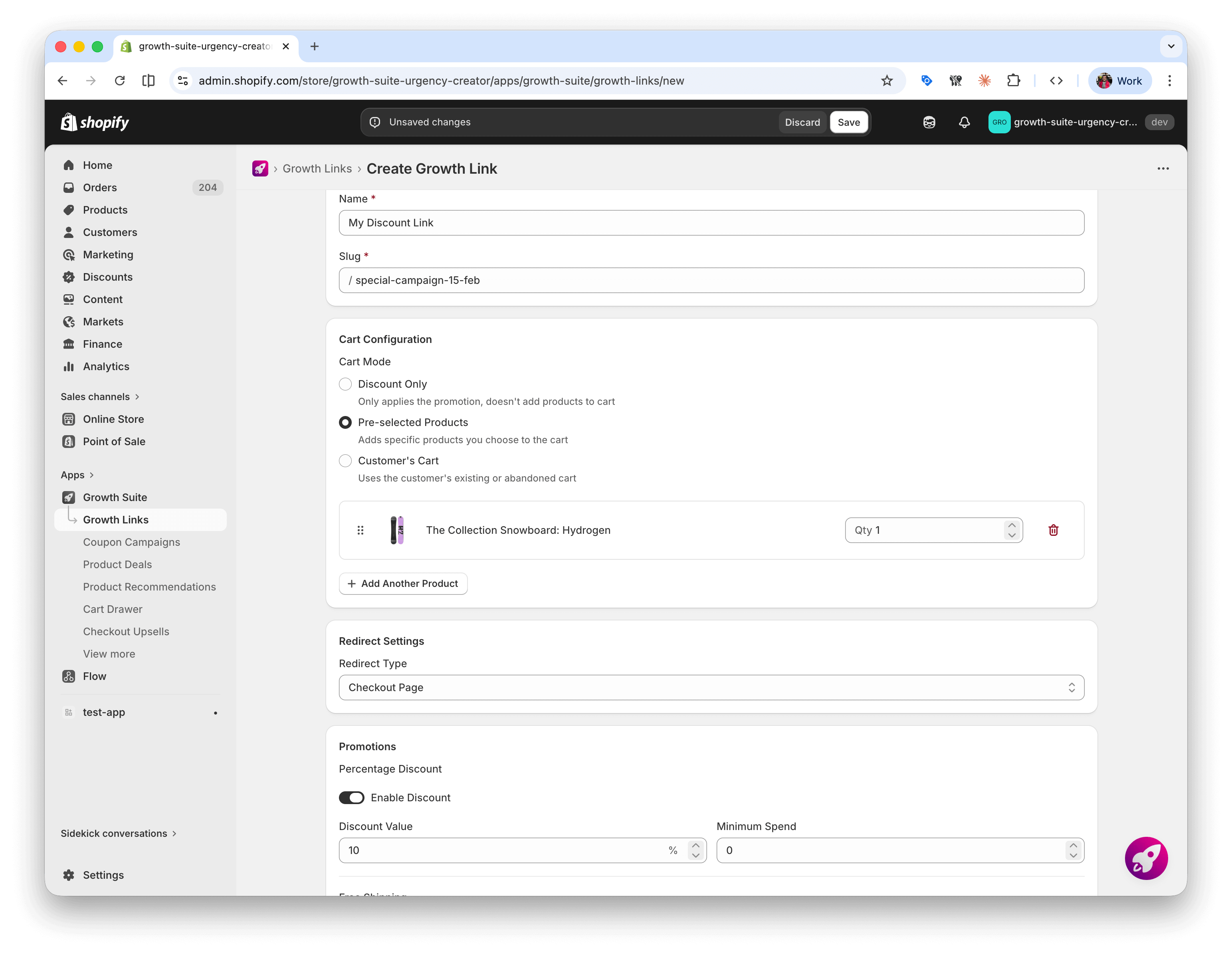
Warning: Do not spread your BFCM ad budget evenly across all channels. Allocate based on expected return: email first (near-zero cost, highest conversion), then paid search (high intent), then paid social (retargeting priority), then organic social (awareness). Growth Links let you measure actual conversions per channel so next year's allocation is data-driven.
Dedicated Buyers vs Walk-Away Customers During BFCM
The dedicated buyer versus walk-away customer dynamic matters most during BFCM because of the sheer volume of both types. Understanding this split is central to this bfcm shopify guide.
A BFCM dedicated buyer has been tracking a specific product for weeks. Their search query is "Sony WH-1000XM5 Black Friday deal" not "best headphones on sale." They will purchase at 15% off. Showing them 30% wastes 15 points of margin on a sale that was already going to happen. In 2025, approximately 40% of BFCM purchases came from shoppers who arrived knowing exactly what they wanted.
A BFCM walk-away customer is browsing across multiple stores with no brand loyalty. They add items to carts on 3-5 stores, then decide based on price, urgency, and convenience. They have high cart abandonment risk. They need a compelling reason to buy NOW instead of checking one more store. This is exactly who Trigger Campaigns are built for.
The Margin Math
Without behavioral targeting, all visitors see the same discount. Dedicated buyers (about 40% of traffic) receive discounts they did not need. Pure margin waste. With Trigger Campaigns, dedicated buyers purchase at the standard campaign price. Walk-away customers receive a personalized nudge. The compound effect on a $50,000 BFCM weekend: saving 3-5 percentage points of unnecessary discount on 40% of purchases saves $600-$1,000 in pure margin. That margin savings comes with zero reduction in conversion. Your bfcm discount planning should always include this behavioral layer.
Key Insight: During BFCM, approximately 40% of purchasers arrive knowing exactly what they want. Every additional discount point applied to their order is pure margin loss. Trigger Campaigns ensure only the walk-away visitors receive the extra personalized offer. Scale that margin protection across thousands of BFCM transactions and the impact is substantial.
Post-BFCM: The Transition That Separates Winners
BFCM does not end on Cyber Monday. The 48 hours after Cyber Monday are the most important analytical window of the year. This is Phase 3 of your bfcm campaign strategy 2026.
The Post-BFCM Analysis
Calculate true profit first. Revenue minus discount cost minus ad spend minus creative costs minus operations. Revenue alone is misleading. A campaign that generated $50,000 at 25% average discount with $5,000 in ad spend has a very different profit picture than $40,000 at 15% discount with $2,000 in ad spend. Identify which hero products drove the most profit. Use Growth Links data to see exact conversion and revenue per channel. Document what went wrong: stock-outs, email deliverability issues, cart abandonment spikes. Every strong bfcm shopify guide will tell you that this post-campaign analysis determines next year's success.
Example A: $50,000 - $12,500 - $5,000 - $1,500 - $500 = $30,500
Example B: $40,000 - $6,000 - $2,000 - $1,000 - $500 = $30,500
Same profit. Very different strategies. Always calculate true profit.
The BFCM-to-Christmas Transition
The stores that win December are the ones that use BFCM data to immediately plan Christmas. Your cyber monday shopify campaign results tell you which products and which channels to prioritize for the holiday gift-buying season. You have three transition options.
| Option | When to Use | Pricing Action | Messaging Shift |
|---|---|---|---|
| Clean Break | Premium brands | Full price immediately | Pause, then Christmas launch |
| Clearance Bridge | Remaining BFCM inventory | Reduce to clearance levels | "Final sale" to "Holiday gifts" |
| Direct Flow | Natural BFCM-Christmas overlap | Adjust discount depth | "Deals for you" to "Gifts for them" |
Regardless of which option you choose, the key deliverable is a one-page retrospective: what worked, what failed, what to change for next year's BFCM. Phase 3 of BFCM is Phase 1 of Christmas. The black friday ecommerce strategy that generates the best data also gives you the strongest head start on December.
The Complete BFCM Stack with Growth Suite
A winning black friday shopify strategy layers multiple tools together. Each feature plays a different role. Here is how the complete stack works for your shopify bfcm checklist.
| Layer | Feature | Role in BFCM | When Active |
|---|---|---|---|
| 1 | Scheduled Campaign | Event framework + countdown timer | Nov 27-30 |
| 2 | Trigger Campaigns | Walk-away conversion + margin protection | Nov 27-30 (peak days) |
| 3 | Product Price Editor | Ad-visible pricing + per-product control | Oct 27 onward (early-bird) |
| 4 | Product Deals | Deal rotation + fresh product discovery | Nov 27-30 (daily rotation) |
| 5 | Growth Links | Channel attribution + frictionless landing | Oct onward (all phases) |
| 6 | A/B Testing | Pre-peak optimization | Sep-Oct |
| 6 | Email Capture | VIP list building for early-bird access | Sep - Nov 15 |
| 6 | Post-Purchase Upsell | AOV maximization after purchase | Nov 27-30 |
| 6 | Cart Drawer | Tiered progress bar + product suggestions | Throughout |
How the Layers Work Together
Layer 1 sets the event framework. Your Scheduled Campaign with a countdown timer tells every visitor "BFCM is happening." Tiered storewide discounts encourage bigger carts: Spend $75 get 10% off, Spend $150 get 15%, Spend $250 get 20%.
Layer 2 handles individual walk-away visitors. Trigger Campaigns present personalized, time-limited offers to visitors whose behavior says they are about to leave. Unique codes. Server-side enforcement. Genuine expiration. This is the layer that answers "why buy NOW?" while protecting margins on dedicated buyers.
Layer 3 makes your discounts visible to ad platforms. Product Price Editor changes actual prices with Compare At values. Google Shopping and Meta Ads show your sale price automatically. One-click rollback when BFCM ends.
Layer 4 keeps the shopping experience fresh. Product Deals rotate featured items throughout the 4-day weekend. Discovery Popups showcase current deals. Dynamic badges mark deal items on product pages.
Layer 5 tracks everything. Growth Links give you unique, trackable URLs for every channel. After BFCM, you know exactly which email, influencer, or ad campaign drove actual revenue.
Layer 6 is the supporting cast. A/B Testing optimizes your Trigger Campaign settings before peak traffic arrives. Email Capture builds your VIP list during September and October. Post-Purchase Upsells suggest complementary products after checkout. The Cart Drawer shows tiered discount progress and AI-powered product suggestions.
This complete stack is what separates a structured bfcm campaign strategy 2026 from a "launch a 25% off sale and hope for the best" approach. Each layer solves a different problem. Together, they cover every phase of the black friday shopify strategy from September preparation to December transition.
Key Insight: Think of BFCM campaign tools as layers, not alternatives. The Scheduled Campaign sets the event framework. Trigger Campaigns handle walk-away visitors. Product Price Editor makes your discounts visible on ads. Growth Links measure every channel. Each layer solves a different problem. Stack them together for maximum impact on your shopify bfcm checklist.
What if every discount went to the right person?
Growth Suite predicts purchase intent and shows time-limited offers only to visitors who need them.
In This Article
References & Sources
Research and data backing this article
Muhammed Tüfekyapan
Founder of Growth Suite
Muhammed Tüfekyapan is a growth marketing expert and the founder of Growth Suite, an AI-powered Shopify app trusted by over 300 stores across 40+ countries. With a career in data-driven e-commerce optimization that began in 2012, he has established himself as a leading authority in the field.
Stop giving discounts to everyone.
Growth Suite watches each visitor, predicts purchase intent, and makes one real, time-limited offer—only to those who need it.
Try Free for 14 DaysRelated Articles
BFCM Preparation Timeline: The 8-Week Countdown Checklist for Shopify Stores
Start your Black Friday prep on September 1, not November 1. This week-by-week checklist covers goal-setting, A/B testing, VIP early-bird launches, and late-starter rescue plans for 6, 4, or 2-week timelines.
BFCM Discount Strategy & Pricing: How to Set the Right Discount for Every Phase
The average BFCM discount in 2025 was 24%, but brands with the lowest discounts saw the highest growth. Learn the descending model, category benchmarks, product-level pricing, tiered discounts, and how to stop the profit leak from blanket codes.
BFCM Countdown Timer & Urgency Strategy: How to Create Real Urgency That Converts
Only 50% of BFCM shoppers trust the deals they see. Countdown timers can lift conversions by 106% or reduce sales by 67%. Learn the trust crisis data, double urgency effect, day-by-day timer strategy, and mobile urgency optimization for genuine BFCM countdowns.
BFCM Email & Growth Links Campaign: How to Distribute, Track, and Convert Every Channel
Email drives 30-50% of BFCM revenue, but most stores send the same blast to their entire list and cannot track which channel converts. Learn the 5-email BFCM sequence, VIP early-access strategy with 2x spend data, Growth Links for frictionless distribution and real attribution, and email segmentation by shopper behavior.
BFCM Post-Analysis & Cyber Monday Transition: How to Turn BFCM Data into Christmas Revenue
Revenue is not profit. The 48 hours after Cyber Monday are your most important analytical window. Learn the true BFCM profit calculation, how to find winning products and channels using Growth Links data, three BFCM-to-Christmas transition strategies, and how to build your Christmas campaign directly from BFCM learnings.
Continue Reading
More articles you might enjoy
Shopify Holiday Campaign Planning: The Complete Year-Round Strategy Guide

Christmas & Holiday Season for Shopify: The Complete Campaign Guide (2026)
Amazon Prime Day Counter-Sale Campaign: How to Ride the Wave Amazon Creates

Back to School Campaign Guide for Shopify Merchants
Boxing Day Campaign: The Complete Shopify Strategy for the UK's Biggest Sale Event
Mother's Day Shopify Campaign: The Complete Strategy Guide for E-commerce Merchants
Frequently Asked Questions
Common questions about this topic