Product Bundling and Volume Discount Strategies for Shopify
Product bundling changes the buying decision from "should I buy this?" to "which combination gives me the best deal?" Learn the 3 bundling models, pricing sweet spots, and when NOT to bundle.

Muhammed Tüfekyapan
Key Takeaways
- 1 Product bundling increases AOV by changing the decision from 'should I buy this?' to 'which combination gives me the best deal?' A $40 single item becomes a $70 bundle order.
- 2 Three bundling models work on Shopify: fixed bundles for curated sets, mix-and-match for customer choice, and volume discounts for buying more of the same product.
- 3 The pricing sweet spot is 10-20% off the individual total. Below 10% the deal feels meaningless. Above 20% you are giving away margin without much extra acceptance.
- 4 Not every product should be bundled. Avoid forced bundles with no logical connection, low-margin items together, or products customers already buy together at full price.
- 5 Always show individual price vs bundle price side by side. A bundle showing '$83 value for $70' feels like a real deal even though the discount is only 15%.
- 6 Volume discounts like Buy 2 Save 10% and Buy 3 Save 15% work best for consumable products. The tier gap should be at least 5% between levels to motivate the next step.
Product bundling works because it changes the buying decision. Instead of "should I buy this?", the customer thinks "which combination gives me the best value?" That simple shift increases order sizes. A customer buying a $40 moisturizer alone gives you $40 AOV. The same customer buying a 3-product skincare bundle for $70 gives you $70.
This guide covers the 3 product bundling strategy models for Shopify, how to price bundles without destroying your margins, how to choose the right products, and the question most guides skip: when NOT to bundle.
Bundling is different from cross-selling. Cross-selling suggests related products. Shopify product bundles package them together at a combined price. The customer sees a clear deal. And you see a bigger order.
The AOV math: A customer buying a $40 product alone gives you $40. The same customer buying a 3-product bundle for $70 gives you $70 AOV. Product bundling didn't require a new customer, more traffic, or a higher conversion rate. Just a smarter way to present your products.
The 3 Product Bundling Models for Shopify
Not all bundles work the same way. There are 3 distinct models. Each one fits different product types and customer behaviors.
Model 1: Fixed Bundles
You pick the products. The customer gets a curated set at a packaged price.
Example: "The Complete Skincare Routine" with cleanser, toner, and moisturizer for $70 (individually $83). The customer gets a deal. You control the product mix and optimize for margin.
Fixed bundles work best for products that naturally go together. Skincare routines. Starter kits. Gift sets. Outfit combinations. The customer shouldn't have to think "do these make sense together?" It should be obvious.
Model 2: Mix-and-Match
The customer picks items from a qualifying group.
Example: "Pick any 3 tees for $60." The customer has freedom to choose. This works best when you have many similar products like t-shirts, socks, supplements in different flavors, or food items.
The advantage: personalization increases perceived value. Customers feel like they built their own deal.
Model 3: Volume Discounts
Buy more of the same product, pay less per unit.
Example: "Buy 2 Save 10%. Buy 3 Save 15%." This works best for consumable and repeat-purchase products. Supplements. Coffee. Pet food. Cleaning supplies.
The advantage: it increases units per order and locks in repeat purchase behavior. Customers stock up, and your shopify bundling strategy builds long-term value.
| Bundling Model | How It Works | Best For | AOV Impact | Example |
|---|---|---|---|---|
| Fixed Bundle | Curated set at packaged price | Complementary products | High (+30-75%) | Skincare routine: 3 products for $70 |
| Mix-and-Match | Customer picks from group | Similar product variants | Medium-High (+20-50%) | Pick any 3 tees for $60 |
| Volume Discount | Buy more, pay less per unit | Consumables, repeat products | Medium (+15-40%) | Buy 2 Save 10%, Buy 3 Save 15% |
Key Insight: Fixed bundles give you the most control over margins. Mix-and-match gives customers the most satisfaction. Volume discounts build the strongest repeat purchase behavior. Choose based on your product type.
Bundle Pricing: How to Set Prices That Protect Your Margins
The pricing sweet spot for most Shopify product bundles is 10-20% off the individual item total. Below 10%, the deal doesn't feel meaningful. Above 20%, you're giving away margin for minimal extra acceptance.
Here's the key: perceived savings matters more than actual discount depth. A bundle showing "$83 value for $70" feels like a real deal. The customer sees $13 in savings. Even though the 15% discount is modest, the dollar amount makes it tangible.
Always show the comparison. "Individual price: $83. Bundle price: $70. You save $13." Without the comparison, the deal is invisible.
| Bundle Discount | Customer Perception | Margin Impact | Recommendation |
|---|---|---|---|
| 5-9% | "Barely a deal" | Minimal impact | Too low for most products |
| 10-15% | "Good value" | Moderate, manageable | Sweet spot for most stores |
| 16-20% | "Great deal" | Noticeable, needs monitoring | Use for high-margin products |
| 21%+ | "Must-buy" | Significant margin erosion | Only for clearance or loss-leaders |
Volume Discount Pricing
For volume discounts, make the gap between tiers noticeable. At least 5% between each tier.
- 1 unit: $30 (full price)
- 2 units: $54 ($27 each, 10% off)
- 3 units: $76.50 ($25.50 each, 15% off)
"Buy 2 Save 5%, Buy 3 Save 6%" doesn't motivate anyone. The jump is too small. Each tier needs to feel like a real step up.
The Margin Check
Before launching any bundle, calculate your cost per unit. Never let the bundle price drop below cost plus your minimum margin requirement. A popular bundle that loses money on every sale is worse than no bundle at all.
The math in your favor: A 15% bundle discount on an $80 bundle means the customer saves $12. You lose $12 on the discount but gain $50+ in additional items the customer would not have bought individually. The net result is a much larger order.
How to Choose Products for Bundles
Not every product should be bundled. The best product bundles feel obvious to the customer. "Of course these go together."
Rule 1: Products Must Have a Logical Connection
Same routine. Same activity. Same room. The connection should be clear without explanation.
Good example: running shoes + moisture-wicking socks + shoe cleaner. Same activity. Clear connection.
Bad example: phone case + kitchen timer. No logical connection. The customer won't see value in that combination.
Rule 2: Include a Best-Seller in Every Bundle
Every bundle needs an anchor product. A popular item that draws attention. The other items in the bundle ride on the anchor's appeal. If nobody wants the lead product, nobody will buy the bundle.
Rule 3: Use Purchase Data to Find Natural Pairings
Your order history reveals which products customers actually buy together. Frequently Bought Together data is the most reliable source for bundle ideas. If customers already buy items A and B together, a bundle makes it official.
Rule 4: Balance Margins Across the Bundle
Include at least one high-margin item in every bundle. A bundle with a high-margin accessory ($18 cost, $35 retail) and a lower-margin main product ($30 cost, $50 retail) can handle a bigger discount. The accessory absorbs it.
Tip: Start with your top-selling product. Look at what customers buy alongside it. That's your first product bundling strategy idea. The data already has the answer.
When NOT to Bundle: The Question Most Guides Skip
The question "what should I bundle?" gets all the attention. The question "what should I NOT bundle?" is equally important.
Don't Bundle Products with No Connection
Forced bundles feel like clearance dumps. If you bundle slow-moving inventory with a popular product hoping to clear stock, customers see through it. It damages brand trust.
Don't Bundle Low-Margin Items Together
Bundling two 15%-margin products with a 15% bundle discount means near-zero profit on those orders. Always check the margin math before launching.
Don't Bundle Items Customers Already Buy Together at Full Price
This is the cannibalization trap. If customers already buy products A and B together at full price, bundling them at a discount doesn't increase AOV. It decreases revenue. You just gave away money on orders that were already happening.
Only bundle products that customers would not typically buy together without the incentive.
Don't Over-Bundle
A store with 10 different bundle options creates decision fatigue. The customer doesn't know which to pick and ends up picking nothing. Start with 2-3 bundles maximum. Test. Refine. Then add more if the data supports it.
Warning: If customers already buy two products together at full price, bundling them at a discount doesn't increase AOV. It decreases revenue. Only bundle products that need the incentive to be purchased together. Good shopify bundling is selective, not exhaustive.
Testing Bundle Configurations for Maximum AOV
The first bundle you create won't be the best one. Testing reveals which combinations and price points perform best.
What to Test
- Bundle composition: Which products are included? Test your top seller with 2-3 different companion products.
- Discount level: 10% vs 15% vs 20%. Find the sweet spot for your margins and acceptance rate.
- Presentation: How the bundle appears on the product page. Different layouts and labels can produce different results.
The Right KPI
Most testing tools optimize for conversion rate. For bundles, AOV is the more relevant metric. You want to know which bundle produces the highest average order value, not just the most clicks. A bundle that gets lots of clicks but doesn't increase order value isn't doing its job.
How to Start
Take your top-selling product. Create 2-3 different bundle combinations. Test each one for 2 weeks. Compare which pairing produces the highest AOV. That's your winner.
Then test the discount level on the winning combination. 10% vs 15%. Keep the one that produces the best balance of acceptance rate and margin.
Testing is how you move from good bundles to great bundles.
How Growth Suite Supports Bundling and Volume Strategies
Most bundling tools handle one model. Growth Suite supports multiple approaches from one platform.
Frequently Bought Together for automatic cross-sell bundles. The system identifies which products customers naturally purchase together and suggests them on product pages. These are data-driven bundles that improve automatically as you get more orders.

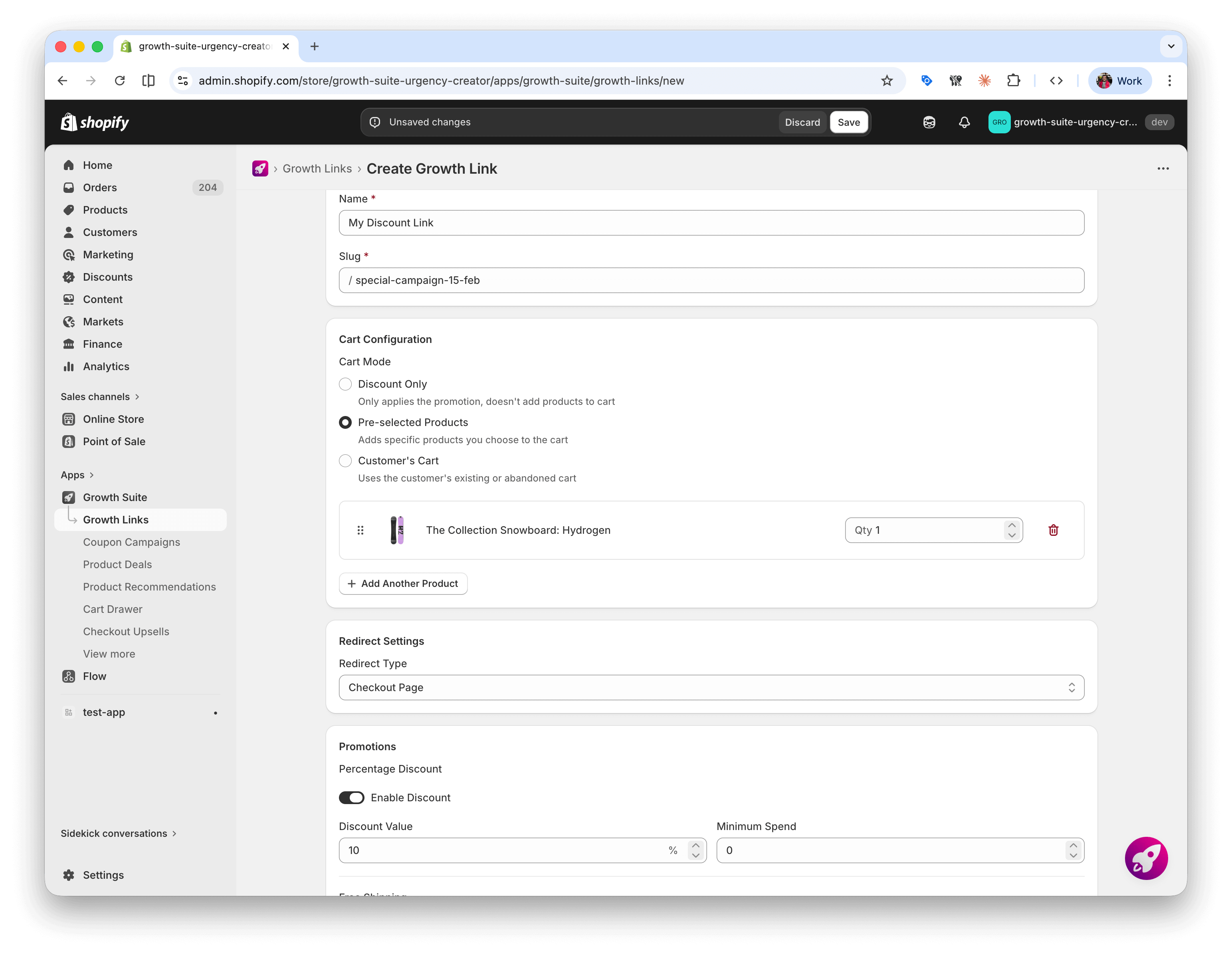
Growth Links for curated promotional bundles. Create a URL that pre-fills the cart with a specific product combination. Share it via email, social media, or ads. One click and the bundle is in the cart. Perfect for "click to bundle" campaigns.
Tiered Storewide Discounts for volume incentives. The spend-based progression naturally encourages customers to add more items to reach the next discount tier. 10% at $50, 15% at $100, 20% at $150.
A/B Testing with AOV as the primary KPI. Test which bundle composition, discount level, or display format produces the highest average order value. Not just conversion rate. AOV.
Because everything runs on one platform, the data is shared across all bundling features. The system learns from every order and gets smarter over time.
The advantage: Growth Suite supports all three bundling models. FBT for automatic complementary bundles. Growth Links for curated promotional bundles. Tiered discounts for spend-based volume discount incentives. Test which model works best for your store with built-in A/B testing.
7 Best Shopify Upsell Apps: Touchpoint Coverage Matrix Included
Over 100 upsell apps on Shopify. We compared 7 best across all 4 touchpoints with honest pros, cons, real pricing, and decision frameworks by goal, budget, and store size.
What if every discount went to the right person?
Growth Suite predicts purchase intent and shows time-limited offers only to visitors who need them.
In This Article
References & Sources
Research and data backing this article
Muhammed Tüfekyapan
Founder of Growth Suite
Muhammed Tüfekyapan is a growth marketing expert and the founder of Growth Suite, an AI-powered Shopify app trusted by over 300 stores across 40+ countries. With a career in data-driven e-commerce optimization that began in 2012, he has established himself as a leading authority in the field.
Stop giving discounts to everyone.
Growth Suite watches each visitor, predicts purchase intent, and makes one real, time-limited offer—only to those who need it.
Try Free for 14 DaysContinue Reading
More articles you might enjoy

Shopify AOV Benchmarks by Industry: Where Does Your Store Stand?
Free Shipping Threshold Strategy: The #1 Way to Increase AOV
AOV Calculator: Measure and Optimize Revenue Per Order

Best Shopify Upsell & Cross-Sell Apps (2026)

The Psychology of Upselling: Why Customers Say Yes

Shopify Upselling & Cross-Selling: The Complete Guide
Frequently Asked Questions
Common questions about this topic