Percentage Off vs. Fixed Amount Discounts: Which Converts Better?
Same discount, different framing—one converts 25% better. Learn the Rule of 100, when each type wins, and why targeting matters more than the discount type itself.

Muhammed Tüfekyapan
Key Takeaways
- 1 Apply the Rule of 100: percentage discounts for products under $100, fixed amounts for products over $100
- 2 Shoppers pick the bigger number, so compare the percentage and the dollar amount and show whichever looks bigger
- 3 A fixed amount discount is also called a flat discount or dollar-off discount, and it costs the same no matter what lands in the cart
- 4 Fixed amounts create a finish line that stops cart growth, while percentage discounts keep rewarding bigger carts with no ceiling
- 5 A discount costs you a share of profit, not revenue: at a 40% margin, a 20% discount wipes out half your profit on every sale
- 6 Who sees the discount matters more than the type; for behavioral campaigns, percentage discounts plus smart targeting win
- 7 No one can honestly claim one type converts better, so test discount depths with A/B tests on your own audience
Quick answer: For products under $100, a percentage discount usually converts better, because "20% off" an $80 product feels bigger than "$16 off." For products over $100, a fixed amount usually wins, because "$40 off" a $200 product beats "20% off." Shoppers go for the bigger number. This is called the Rule of 100, and it gets the decision right most of the time. One catch: who sees the discount matters more than the type. Shown to people who would have paid full price anyway, both types waste margin.
You're about to launch a sale on your $80 product. You could offer "20% off" or "$16 off."
Same savings. Same math. But one of these two offers will convert better than the other, and the wrong choice does not just cost you sales today. It shapes how customers see your prices for months.
Most merchants pick one without thinking. They go with their gut. You do not have to. There is a simple rule that gets this decision right most of the time, and there is a smarter approach that protects your margins no matter which type you use.
In this percentage off vs fixed amount discount comparison, you will learn:
- Exactly when to use a percentage or dollar off discount
- The psychology behind why one converts better than the other
- Why the "type" debate might be the wrong question
- A smarter approach that protects your margins either way
Percentage vs. Fixed Amount: The 30-Second Comparison
| Factor | Percentage Off | Fixed Amount |
|---|---|---|
| Best for | Products under $100 | Products over $100 |
| Psychology | Feels bigger on low prices | Feels bigger on high prices |
| Mental math | Easy on round numbers | Always clear |
| Margin risk | Scales with price | Fixed, predictable |
| Cart growth | Keeps rewarding bigger carts | Stops at the threshold |
The rest of this guide explains each row and shows you the math behind it.
What Is a Percentage Discount?
A percentage discount takes a proportion off the price. The savings grow as the price grows.
- 20% off a $50 product saves $10. The customer pays $40.
- 20% off a $200 product saves $40. The customer pays $160.
- 20% off a $500 product saves $100. The customer pays $400.
Same percentage, very different dollars. That is both the power and the risk of percentage discounts, as the math section will show.
Deep Dive: The Ultimate Guide to Percentage Off Discounts
Stop guessing. Learn the psychology, the hidden math, and the exact strategies to use discounts profitably without destroying your margins.
What Is a Fixed Amount Discount?
A fixed amount discount takes a set number of dollars off the price. You will also see it called a flat discount, a flat dollar amount, or a dollar-off discount. They all mean the same thing. "$20 off" is "$20 off," no matter what the customer buys.
- $20 off a $50 product is 40% savings. The customer pays $30.
- $20 off a $200 product is 10% savings. The customer pays $180.
- $20 off a $500 product is 4% savings. The customer pays $480.
The savings stay constant. That gives you predictability, but it also creates a different feeling in the customer's mind. More on that in a minute.
Deep Dive: The Ultimate Guide to Fixed Amount Discounts
This is the only guide you need for Fixed Amount Discounts. Master the "$ Off" psychology, learn when it beats percentage discounts, and apply the "Rule of 100" to maximize your high-ticket sales.
The Core Difference: Scaling
Almost everything in this guide comes back to one idea:
- Percentage discounts scale. Your margin cost grows as the cart grows.
- Fixed discounts stay flat. Your margin cost is known before you launch.
Neither one is "better" on its own. The right choice depends on your price point, your goal, and (the part most guides skip) who you show the discount to.
How Shopify Handles Both Types
Three small technical details worth knowing before you set anything up:
- Truncation. Shopify cuts percentage calculations at 2 decimal places instead of rounding. 10% off $7.75 comes out to $0.77 off, not $0.78.
- Stacking. When multiple discounts combine, Shopify calculates each one against the original price, not one after another.
- Clean totals. Fixed amounts always produce exact prices. Percentages can leave odd cents like $47.23.
These details rarely change your strategy. But if you run stacked or complex promotions, keep them in mind.
The Psychology: Why One Discount Feels Bigger
Here is where it gets interesting. The exact same savings can feel completely different depending on how you frame them.
The Rule of 100
The most useful principle in the percentage off vs fixed amount debate comes from marketing researcher Jonah Berger. It goes like this:
The Rule of 100:
- Under $100: percentage discounts feel bigger.
- Over $100: dollar discounts feel bigger.
Watch it in action:
| Product Price | 20% Off | Dollar Equivalent | Which Feels Bigger? |
|---|---|---|---|
| $50 | "20% off" | "$10 off" | 20% off wins (20 > 10) |
| $80 | "20% off" | "$16 off" | 20% off wins (20 > 16) |
| $100 | "20% off" | "$20 off" | Tie (20 = 20) |
| $200 | "20% off" | "$40 off" | $40 off wins (40 > 20) |
| $500 | "20% off" | "$100 off" | $100 off wins (100 > 20) |
Customers go for the bigger number. It is not logical, it is perceptual. And it works.
We wrote a full guide with the research and more examples: The Rule of 100: Complete Guide to Discount Perception Psychology.
Mental Math and Cognitive Load
"Save $30" is instant. You get it right away.
"Save 17.5%" takes work. Your brain has to calculate, and in that moment of hesitation, you lose momentum.
This is why fixed amounts are always clear, and why percentage discounts work best on round numbers. 10%, 15%, 20%, and 25% are easy to compute in your head. 17% or 23% just create friction.
Anchoring: Where the Brain Parks the Number
One more effect worth knowing:
- A percentage discount anchors the shopper to the original price. They calculate savings from there.
- A fixed discount anchors them to the savings itself. "$50 off" becomes real money in their mind. They can picture what else $50 buys.
That is why fixed discounts feel so tangible on expensive items. "$100 off this $800 sofa" feels like cash in your pocket. "12.5% off" floats in the air.
Put it all together and you get one working principle: ask "which number is bigger?" That is the number your customer will feel.
When to Use Each Discount Type
Now let's turn psychology into strategy.
The Price Threshold Rule
Based on the Rule of 100:
- Products under $100: use percentage.
- Products over $100: use fixed amount.
- Products at exactly $100: test both. This is the inflection point.
Why $100? That is roughly where perception flips. Below it, percentages win. Above it, dollars win.
Cart Growth vs. Margin Control
Here is what most comparison guides miss. The two types behave very differently once the customer starts shopping.
A fixed discount creates a finish line. Take "$25 off orders over $100." The customer builds a cart to $102, hits the threshold, and stops. Mission accomplished. You accidentally told them where to stop adding items.
A percentage discount has no finish line. "20% off your order" means a $100 cart saves $20, a $150 cart saves $30, and a $200 cart saves $40. The reward keeps growing, so the customer always has a reason to add one more item.
| Factor | Fixed Amount | Percentage |
|---|---|---|
| Cart growth incentive | Stops at the threshold | Keeps rewarding |
| Margin predictability | High, exact cost known | Variable, scales with cart |
| Big spenders feel | The same as everyone else | Proportionally rewarded |
| Over-discounting risk | Lower | Higher on large carts |
The honest view: if growing average order value is your main goal, percentage usually wins. Fixed amounts shine for high-ticket single items, controlled-budget campaigns, and win-back offers.
Use Case Matrix
| Scenario | Recommended Type | Why |
|---|---|---|
| Low-ticket products (under $50) | Percentage | "20% off" sounds bigger than "$10 off" |
| Mid-ticket ($50 to $100) | Percentage | Still feels more valuable |
| High-ticket ($100 to $300) | Fixed amount | "$30 off" sounds bigger than "10% off" |
| Premium ($300+) | Fixed amount | "$100 off" creates real impact |
| Store-wide sales | Percentage | Simple to communicate, grows carts |
| VIP and loyalty rewards | Fixed amount | Feels like real money, a personal gift |
| Clearance and dead stock | Percentage | A high percentage creates urgency |
| Cart growth focus | Percentage | No ceiling on the reward |
Industry Notes
Fashion & Apparel (Usually Under $100)
- Default to percentage.
- Exception: designer or luxury pieces, where a fixed amount reads better.
Beauty & Cosmetics ($20 to $80)
- Percentage works best for single products.
- For bundles, a fixed amount can work well. "Save $25 on this set" is clear and tangible.
Home & Furniture ($200+)
- Fixed is stronger.
- "$200 off this sofa" beats "10% off this sofa."
Electronics (Wide Price Range)
- Apply the Rule of 100 strictly.
- Accessories under $100 get percentage. Devices over $100 get fixed.
Grocery & CPG
- Margins are thin and carts are large, so keep the depth shallow whichever type you use.
- Selling outside the US? The same logic applies in any currency. "£10 off" versus "10% off" is the same comparison: put the two numbers side by side and show the bigger one.
Seasonal and Event-Based Notes
Black Friday and big sale events:
- Percentage creates the excitement. "50% OFF!" is hard to beat as a headline.
- For high-ticket items, show the dollars too. A hybrid line like "50% OFF, save up to $200!" does both jobs.
Welcome offers:
- 10% to 15% off the first order is the standard.
- Stores with a high average order value can test a fixed amount instead, like "$20 off your first order over $100."
Cart abandonment:
- Match the type to your average cart value.
- Low AOV, try a percentage nudge. High AOV, try a fixed nudge.
The Math: What Each Discount Really Costs
Psychology tells you which discount feels better. Math tells you which one costs less. Sometimes they agree. Sometimes they do not, and that is where merchants get burned.
The Discount Multiplier Effect
The biggest math mistake in discounting is thinking of a discount as a percentage of revenue. The real cost is a percentage of profit, and those are very different numbers.
Quick example. You sell a product for $100 with a 40% margin, so your profit is $40. You offer 20% off. That is $20 less revenue, but it is $20 out of your $40 profit. Half your profit is gone, from a "20%" discount.
Here is how the multiplier scales:
| Your Margin | 10% Discount | 15% Discount | 20% Discount | 25% Discount |
|---|---|---|---|---|
| 30% margin | 33% of profit gone | 50% of profit gone | 67% of profit gone | 83% of profit gone |
| 40% margin | 25% of profit gone | 37.5% of profit gone | 50% of profit gone | 62.5% of profit gone |
| 50% margin | 20% of profit gone | 30% of profit gone | 40% of profit gone | 50% of profit gone |
| 60% margin | 17% of profit gone | 25% of profit gone | 33% of profit gone | 42% of profit gone |
Read the middle row again. At a 40% margin, a "small" 20% discount wipes out half your profit on every sale. This effect hits both discount types. The difference is that percentage discounts let it scale without limit as carts grow, while fixed amounts keep it contained.
9 Best Shopify Discount Apps: Find the Right One for YOUR Problem
Stop browsing feature lists. 9 premium apps compared by the 7 problems they solve. Not rankings, not reviews, just honest "use this when..." guidance. Find your perfect match in minutes.
Why Fixed Amounts Give You More Control
A fixed discount costs the same no matter what lands in the cart:
- $20 off a $50 order costs you $20.
- $20 off a $200 order costs you $20.
- $20 off a $500 order costs you $20.
For high-ticket stores, this is the appeal. "$50 off orders over $300" is controlled spending. You know exactly what each conversion costs before you launch.
Break-Even Comparison
One example does not show the full picture, so here are three price points. Each pair of rows compares the two types at roughly similar perceived value.
| Product | Discount | Cost to You | Profit Impact | Break-Even |
|---|---|---|---|---|
| $50 product (50% margin) | 20% off | $10 | 40% of profit | +67% sales |
| $50 product (50% margin) | $10 off | $10 | 40% of profit | +67% sales |
| $200 product (40% margin) | 20% off | $40 | 50% of profit | +100% sales |
| $200 product (40% margin) | $30 off | $30 | 37.5% of profit | +60% sales |
| $500 product (35% margin) | 15% off | $75 | 43% of profit | +75% sales |
| $500 product (35% margin) | $50 off | $50 | 29% of profit | +40% sales |
Two things stand out. At $50, both types cost exactly the same, because $10 is 20% of $50. But at $200 and $500, the fixed amount creates similar perceived value at a much lower margin cost. On the $200 product, the percentage version needs twice as many extra sales just to break even.
If you want to run these numbers for your own catalog, our break-even discount calculator does the work for you.
The Question Most Guides Get Wrong
Most comparison articles put "20% off $200" next to "$40 off $200" and stop there. Same savings, different framing. That teaches you about perception, but it is not how a real pricing decision works.
In real life, you are not choosing between two framings of one number. You are asking a different question: how do I create the strongest perceived value at the lowest margin cost?
That reframes everything:
- Under $100: use percentage. It feels bigger and costs the same as fixed.
- Over $100: use fixed amount. It feels bigger and costs less than percentage.
- Over $100 and you want cart growth: use percentage with a cap. You get both.
The Hybrid Playbook: Caps, Thresholds, and Tiers
You do not have to pick just one type. Three combinations give you control and growth at the same time.
Strategy 1: The cap. "20% off, up to $50 savings." You keep the percentage hook with a hard ceiling on margin loss. Good fit for catalogs with a wide price range. A practical starting point: set the cap at 15% to 20% of your average product price.
Strategy 2: The threshold. "20% off orders over $100." This protects low-margin items and pushes carts upward. Set the threshold slightly above your current average order value. If your AOV is $85, a $100 threshold nudges shoppers to add one more item.
Strategy 3: Tiered fixed amounts. "$10 off $75+, $25 off $150+, $50 off $300+." This fixes the finish-line problem of normal fixed discounts. Instead of one stopping point, you create several milestones. It feels like a fixed discount (tangible dollars) but behaves like a percentage (keeps rewarding bigger carts).
| Strategy | Best For | Margin Control | Cart Growth |
|---|---|---|---|
| Percentage with cap | Wide price range catalogs | Strong, hard ceiling | Moderate, stops at cap |
| Percentage with threshold | Stores raising AOV | Moderate | Strong, no ceiling |
| Tiered fixed amounts | Stores with $100+ AOV | Strong, predictable per tier | Strong, multiple milestones |
Want more on the tiered approach? See Tiered Discounts Strategy: Spend More, Save More.
4 Common Mistakes When Choosing a Discount Type
These are the type-selection mistakes we see most often. For the pitfalls of each type in detail, see our guides on percentage discounts and fixed amount discounts.
Mistake #1: Ignoring the Rule of 100
"10% off" a $500 item sounds weak. "$50 off" is stronger. "$5 off" a $25 item sounds cheap. "20% off" is stronger.
The fix: before every campaign, ask which number is bigger.
Mistake #2: Forgetting the Ceiling Effect
Fixed amounts quietly tell customers where to stop shopping.
The fix: if growing AOV is the goal, percentage usually wins.
Mistake #3: Showing the Same Discount to Everyone
Both types waste margin on dedicated buyers, the people who were going to pay full price anyway. If your targeting leaks money, the type debate is pointless.
The fix: who sees the discount matters more than what type it is. The next section shows you why.
Mistake #4: Guessing Instead of Testing
What works for one catalog can flop in another. Different price points and audiences respond differently.
The fix: let data drive the decision, not your gut.
The Smarter Approach: Targeting Beats Type
Most comparison guides assume you show the same discount to every visitor. That assumption is the real problem, not the discount type.
There is a hierarchy to discount optimization:
- Who sees the discount
- When they see it
- What type it is
- How deep it is
Most merchants obsess over 3 and 4 while ignoring 1 and 2. That is backwards.
A perfectly chosen discount type, shown to everyone, still gives away margin to people who would have paid full price.
Why Percentage Plus Targeting Usually Wins
For automated, behavior-based campaigns, we recommend percentage discounts with smart targeting. The reasons are practical:

- Percentage scales with the cart, so it keeps rewarding shoppers who add more.
- It works across the whole catalog with no per-product setup.
- There is no ceiling effect.
- The targeting protects your margin. Only visitors who show signs of leaving see the offer. Dedicated buyers pay full price.
When Fixed Amounts Still Make Sense
Fixed discounts have a real place in manual, one-off campaigns:
- A single high-ticket product push, like "$100 off this $800 sofa"
- VIP or loyalty rewards, where a dollar amount feels more personal
- Win-back campaigns, like "$20 because we miss you"
The pattern: for behavioral, trigger-based discounting, percentage plus targeting wins. For one-off manual campaigns, apply the Rule of 100.
Testing Discount Depth with Growth Suite
Full disclosure: we build Growth Suite, and it uses percentage-based discounts for all campaigns. That is a deliberate design choice, based on everything you just read.
Once you pick percentage, the real question becomes: what percentage?
Growth Suite's A/B testing for trigger campaigns lets you compare ranges, for example:
- Variant A: 10% to 15% off range
- Variant B: 15% to 20% off range
Track: conversion rate, AOV, and total revenue for each variant.
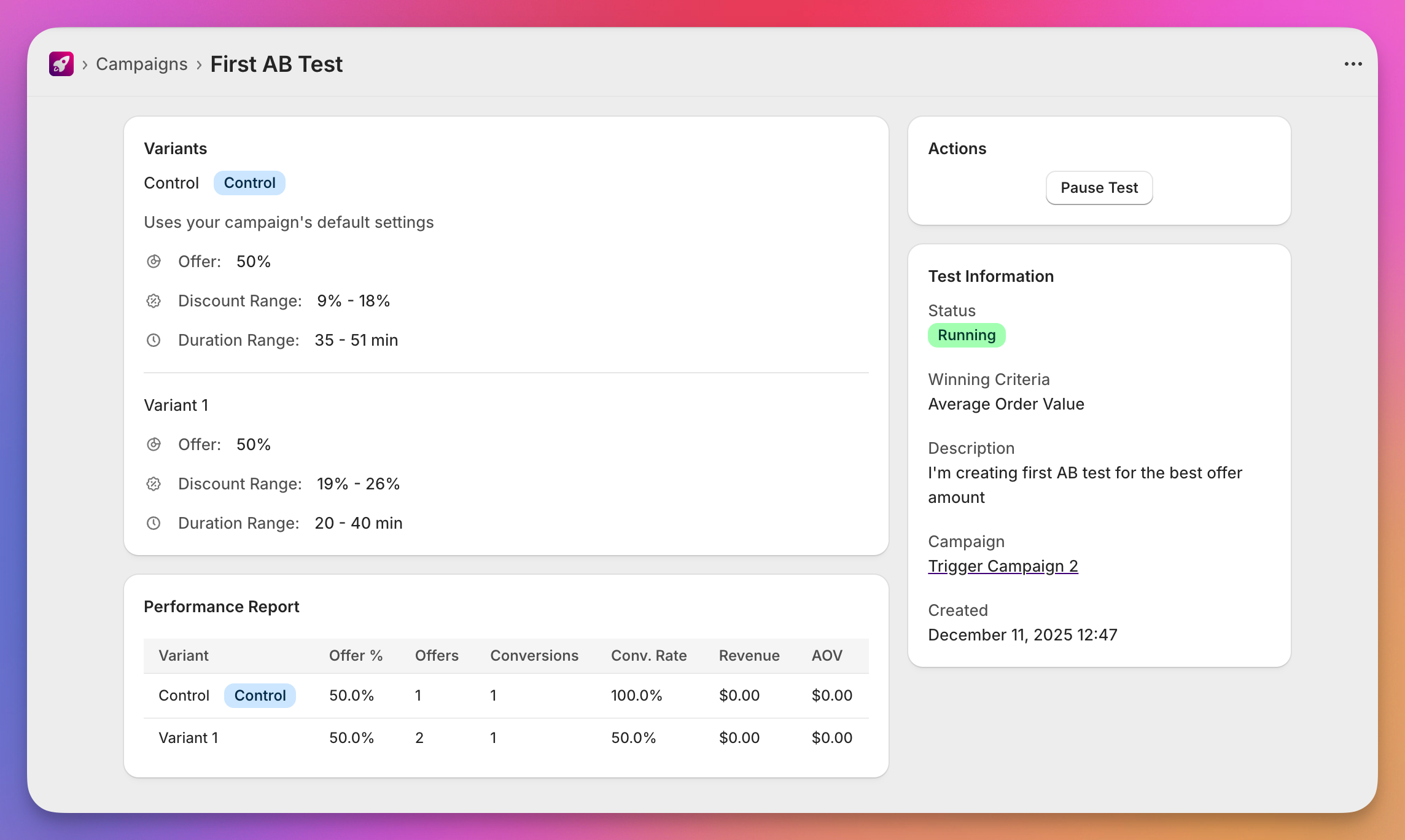
Why bother? Because a deeper discount does not always convert better. For some stores, 15% performs about the same as 20%, which puts 5 points of margin back in your pocket. For others, 10% falls flat and costs sales. Only a test on your own audience tells you which one is true for you.
What We Can and Cannot Measure
You deserve to know where our data ends, so here it is plainly.
What we can measure:
- How conversion changes across different discount depth ranges in A/B tests with holdout groups
- Offer acceptance rates, meaning how often a shown offer gets used
- How offer duration affects results
What we cannot measure:
- Percentage vs. fixed amount, head to head. Growth Suite does not run fixed-amount campaigns, so we cannot produce an honest conversion comparison between the two types. If anyone gives you a precise "percentage converts X% better" number, treat it as a guess, not data.
- Reliable results per store vertical. Our sample does not support per-industry claims yet.
One more technical note, because it matters for how you read any discount data. Growth Suite offers are only shown to visitors who show walk-away behavior, so a "session without an offer" is not a neutral control group. The comparisons that hold up are depth against depth, inside randomized A/B tests. Keep that in mind when you compare numbers from different tools.
The Decision Checklist
Before your next promotion, run through these six questions:
-
What is the product price?
- Under $100 → Percentage
- Over $100 → Fixed amount
-
Which number is bigger?
- "20% off $80" beats "$16 off," because 20 beats 16 → Percentage
- "15% off $300" loses to "$45 off," because 45 beats 15 → Fixed
-
How much margin risk can you take?
- Need predictable costs → Fixed amount
- Can handle variable costs → Percentage
-
What is your AOV goal?
- Want to grow it → Percentage (no ceiling)
- Want controlled spend → Fixed amount
-
What are you promoting?
- One high-ticket item → Fixed amount
- Store-wide sale → Percentage
-
Is this an automated trigger campaign?
- Yes → Percentage with targeting
- No, a manual one-off → Apply the Rule of 100
Conclusion: The Right Tool for the Right Job
Neither discount type wins everywhere.
The winner depends on your price point, your goal, and most of all, who sees the offer.
Three Principles to Keep:
- Perception beats math at the shelf. Use the type that feels bigger. The Rule of 100 is your starting point, not your final answer.
- Targeting beats type. Who sees the discount matters more than what type it is. Dedicated buyers should pay full price.
- For behavioral campaigns, percentage plus targeting wins. It is the combination we recommend, and the one we build for.
The best discount is not the one with the perfect type. It is the one your customer actually needed, and your accountant barely noticed.
What if every discount went to the right person?
Growth Suite predicts purchase intent and shows time-limited offers only to visitors who need them.
In This Article
References & Sources
Research and data backing this article
Muhammed Tüfekyapan
Founder of Growth Suite
Muhammed Tüfekyapan is a growth marketing expert and the founder of Growth Suite, an AI-powered Shopify app trusted by over 300 stores across 40+ countries. With a career in data-driven e-commerce optimization that began in 2012, he has established himself as a leading authority in the field.
Version History
Track updates and improvements to this article
Full rewrite in plain, conversational English, added a Quick Answer section that directly answers whether a percentage or a fixed amount discount converts better, added flat discount and dollar-off terminology definitions, condensed the Rule of 100 section with a link to the dedicated guide, added a transparent What We Can and Cannot Measure data section with A/B testing methodology notes, added multi-currency guidance for non-US stores, added break-even discount calculator resource, expanded the FAQ to 16 questions covering flat discount meaning, real discount cost math, and hybrid cap/threshold/tiered strategies, refreshed key takeaways
Added new Discount Multiplier Effect analysis with profit-impact data across margin levels, expanded break-even comparison to multi-scenario format (3 price points × 2 discount types), added expert-level margin optimization framework, expanded hybrid discount strategies section with cap/threshold/tiered playbook, added Rule of 100 visual infographic
Initial publication
Stop giving discounts to everyone.
Growth Suite watches each visitor, predicts purchase intent, and makes one real, time-limited offer—only to those who need it.
Try Free for 14 DaysRelated Articles

The Rule of 100: Complete Guide to Discount Perception Psychology
Same savings, different framing, and one converts better. Learn the Rule of 100: percentage under $100, dollar amounts over $100. Plus the psychology behind why it works, and what our own store data can (and cannot) prove about the $100 threshold.
Continue Reading
More articles you might enjoy
Deep Dive: The Ultimate Guide to Percentage Off Discounts

Deep Dive: The Ultimate Guide to Fixed Amount Discounts

Tiered Discounts Strategy: Spend More, Save More
Deep Dive: Buy X Get Y (BOGO) Guide

Free Gift with Purchase (GWP) — The "No-Discount" Strategy
Automatic Discounts on Shopify: Pros & Cons (Complete Guide)
Frequently Asked Questions
Common questions about this topic